


Yes, the title of this article may seem intuitive, but it really is not. I’ve read countless articles about survival gardens over the years. They usually cover what to plant, when to plant it, and how to harvest it. That’s all good information. But one thing I almost never see discussed is whether we should even be eating from our food garden in the first place. Or in other words, very little is written about having a prepper garden solely to produce seeds for the future. This article is another example of progression-based preparedness. Rather than asking, “What can I eat today?” it asks, “What decision today creates more food options tomorrow?”
I will unpack this now.
Whether we are dealing with rising food prices, supply chain issues, or simply trying to become more self-reliant, many people have started thinking seriously about growing their own food.
Operating from a position of fear (2 Timothy 1:7) will not help you make clear decisions for you or your family. Storing food for a future event that may or may not happen is not necessarily a bad idea, but it should consist of calorie-dense, nutritious foods that improve your chances of long-term survival. On top of that, planting a survival garden, even if it’s bags of soil on your fifth-story apartment balcony with some radishes and maybe some ground cherries is never a bad idea. For me, I have two large 25’ x 25’ gardens, and two raised beds. I rarely, if ever, eat any of the crops from these gardens. This is usually the point where people give me a funny look, but I tend to manage my backyard garden completely differently. Every year, I plant my crops, wait for everything to flower, and then I harvest all the seeds. As you can see from the picture below, that is 18 carrots in a raised bed. They have all flowered. On the other side are radishes that have started to bolt. The number of seeds I’ll be able to harvest from that tiny crop will be in the thousands.
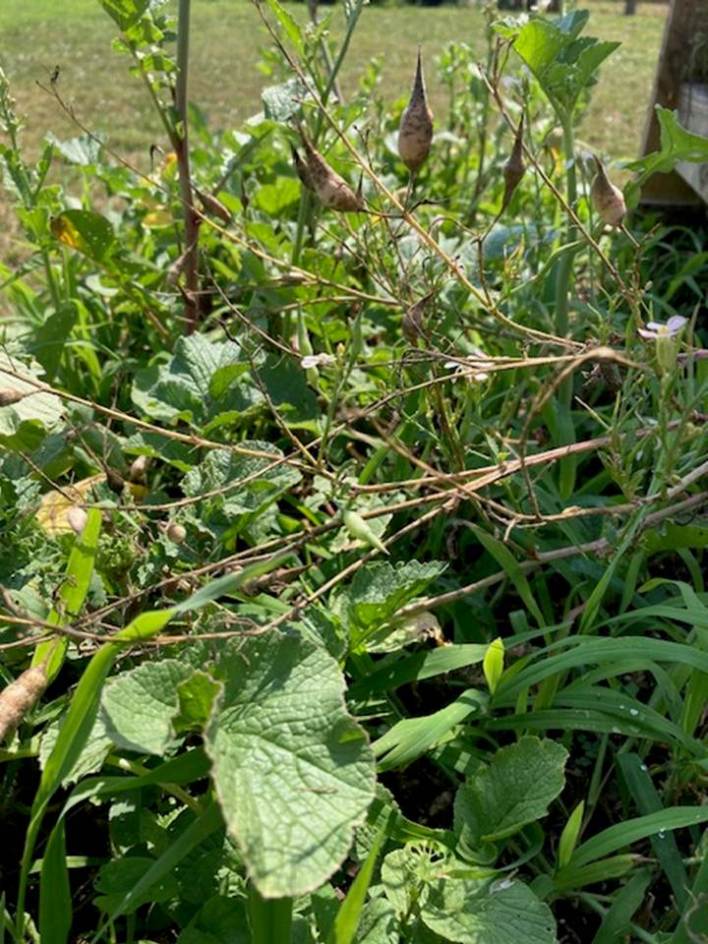
Sgt. Silverman’s radishes allowed to bolt and produce seed pods. Hundreds of seeds from a handful of plants.
CROPS I HAVE SUCCESSFULLY GROWN FOR SEED COLLECTION:
Although this is not an exhaustive list, many fruits and vegetables grown from heirloom or open-pollinated seeds can be managed for seed production. The following crops are ones I have personally grown and successfully collected seeds from over the years:
- Sunflowers
- Pole Beans
- Radishes
- Pumpkins
- Ground Cherries
- Carrots
- Broccoli
- Green & Red Peppers
- Squash
SCENARIO:
Somewhere high in the atmosphere, an electromagnetic pulse knocks out a large portion of the power grid.
You have no cell service, no power, and everything has gone dark.
A quick assessment tells you that you have five weeks of food in the cupboards and a small garden already growing. You now have several options.
Option 1: Ration your stored food while supplementing your calories with seasonal wild edibles and other quiet food, such as freshwater fish. This may allow you to delay harvesting your garden long enough for more crops to flower and produce seed.
Option 2: If you cannot hold out that long, harvest part of the garden for food while allowing the remaining crops to flower and produce seed.
Neither option is perfect, especially once hunger enters the equation. However, seeds represent more than a future food source—they could also become valuable barter items if normal supply systems never return. Food security has now become your number one priority.

WHERE I WOULD START IF I WAS NEW TO ALL OF THIS:
Although this is not an exhaustive list, here are some simple steps for buying, sowing, collecting, and storing seeds from your new seed garden.
- Know your growing zone and learn what grows best in your area. 2023 USDA Plant Hardiness Zone Map | USDA Plant Hardiness Zone Map
- Before you plant anything, learn about testing your soil. Just because it is soil does not mean everything can grow in it.
- Research the differences between raised beds vs. in-ground vs. container gardening.
- Do you have a water source to ensure your crops are being watered properly. Research the different ways to water crops from drip irrigation to watering cans and everything in between.
- Learn the differences between GMO, non-GMO, organic, heirloom and open-pollinated seeds.
- Once you learn all the above basics, research the types of crops you and your family enjoy. I personally loathe carrots, but I grow them because they produce a lot of seeds, and I’ll eat them if I must. I would recommend erring on the side of your family’s preferred tastes whenever possible.
- There are numerous places both online and in stores where you can find heirloom and non-GMO seeds:
- Local hardware stores
- Farm equipment stores
- Home-improvement Centers
- Garden Centers
- Baker Creek Heirloom Seeds (I purchase most of my seeds here – *PERSONAL OPINION / UNPAID RECOMMENDATION)
- Strictly Medicinal Seeds (This is another great resource – *PERSONAL OPINION / UNPAID RECOMMENDATION)
*Unpaid recommendation. Tertiary Prepper receives no commission or compensation from any of these suggestions.
8. Learn the best times to sow your seeds in your growing zone, and when to plant them in your garden.
9. Learn how to collect and properly store your seeds by reading books, online magazine articles and watching videos.
10. Start thinking about your network of contacts, and you may want to consider a small seed bartering exchange system for the future.
Growing seeds primarily for future food security is a tertiary skill that takes time and practice. Also, understanding the relationships between skills (The Quite Food Equation – Fish) often matters as much as the skills themselves. This article is not intended to downplay anyone’s current food plan, nor is it meant to present gardening as a simple right-versus-wrong decision. This approach may not be right for everyone, and that is okay. My goal is simply to challenge you to look at your garden differently—and consider how it might help sustain your family for years to come.
Stay positive, stay resilient, and all the best with growing your seed garden!
Sgt. Silverman
DISCLAIMER:
I am not a licensed nutritionist, financial advisor, or medical doctor. The information in this article is for information purposes only and does not replace professional treatment, diagnosis, or advice. Always check with your physician or qualified healthcare provider with any medical questions, and never disregard professional medical advice based on something you read here.
COPYRIGHT NOTICE
© 2026 Sgt. Silverman / Tertiary Prepper. All Rights Reserved.
This article and all original works published under the pseudonym Sgt. Silverman are the exclusive intellectual property of the author. No portion of this publication may be reproduced, distributed, transmitted, republished, copied, or adapted in any form or by any means without the prior written permission of the author or publisher.
Proper attribution and written permission are required for any use beyond applicable fair use. Unauthorized reproduction, plagiarism, or commercial use may be subject to enforcement under applicable United States copyright laws.
AI-Assisted Visuals & Examples
If you’ve been reading Tertiary Prepper for any length of time, you’ve probably noticed charts, graphs, calculations, and visuals that explain preparedness concepts in ways you don’t normally see discussed. Many of those examples were created with the assistance of artificial intelligence—but only after I gave it very specific instructions on what I wanted to teach.
I don’t use AI to create my preparedness philosophy. I use it to help visualize it.
Many of the tertiary concepts discussed throughout this magazine—such as Sustainment Foraging, Pressure Testing, The Autonomous Recovery Kit (ARK), The Quiet Food Equation, and other original frameworks—are my own ideas and observations. AI simply helps me build charts, graphics, and examples that make those concepts easier to understand.
Preparedness is rarely black and white. There are very few absolute right or wrong answers—only different experiences, different priorities, and different ways of solving the same problem. My hope is that these articles simply give us another reason to sit around the campfire, challenge conventional thinking, and ponder practical solutions together.