


When I was on Active Duty, my Large Alice pack used to hold my SINCGARS radio, spare battery, handset, and whip antenna all weighing in at the low-low weight of around twenty-three pounds. The Alice pack weighed in at give or take, five ‘Ish lbs. This weight was just my gear to perform my job, that weight didn’t include clothes, hygiene items, flashlight, compass, etc. As an Airborne Infantry Forward Observer, this is what we toted at the time, which meant, whatever else you needed, it’d better be a life-or-death necessity. For example, I NEVER carried my military issued sleeping bag. I had my poncho liner, and my camo woobie.
And then there were the ACTUAL life and death necessities, like pogey bait. (In layman’s terms: Non-military issued schnicky schnacks😊)
If you were to go into my ruck, you’d think I robbed a commissary of all the pop-tarts, jolly ranchers and Skoal winter green long-cut. Because thirty days in the field was, well, thirty days in the bush. If you served, you know what I mean. A pop-tart on day twenty-five could yield you some big bucks, let me tell you!
So, what’s my whole point about weight and food? Well, you learn over time that ounces equal pounds, and pounds equal pain. And anyone who’s ever humped a ruck for twenty-five miles can tell you, you try to dump EVERYTHING from your pack that isn’t 100% crucial because a 70-pound pack can feel like 120 by mile fifteen.
HARD LEARNED MILITARY LESSONS:
When I got into hiking eight years ago, I approached it like I was still in the military. When your brain was constantly pounded with the ideology of “two is one and one is none,” you adopted that mentality. Unfortunately, that really isn’t always the right way of thinking. Just because something can be lost or fail doesn’t mean every HEAVY item should have a duplicate. Which is why I learned the hard way to do a proper shakedown of my hiking backpack, because even as an FO, I still humped stuff I didn’t need to have on my back. And, unfortunately, Father Time has kicked in, and hiking in your fifties is a LOT different than rucking in your youth.


CALORIES AND WHY LESS IS MORE:
If you look at the picture above, that’s eight packets of raw coconut butter. Each packet weighs 1.1 ounces and has 200 calories. So, for 8.8 ounces of food—a little over half a pound—that is 1,600 calories, or about 182 calories per ounce. If you take the MRE (Meal, Ready-to-Eat) blueberry pastry as an example, the label shows 270 calories per 2.05-ounce serving, or about 132 calories per ounce.
Before I go any further, I understand that each serving has different amounts of fat, carbohydrates, and protein. And yes, people’s diets are different. And no, I would not want to eat eight packets of coconut butter in a row without a decent amount of dude wipes handy LOL! I’m just trying to explain that calorie density matters when every ounce counts. When considering food for your pack, think about nutritional value, total calories, weight, and what you can actually stomach day after day. Saving even a pound or two of unnecessary weight can make a noticeable difference on a long hike, especially for your knees. Remember, higher calories per ounce do not automatically mean better nutrition. The goal is to balance calorie density with protein, carbohydrates, fats, and food you can realistically eat for several days.
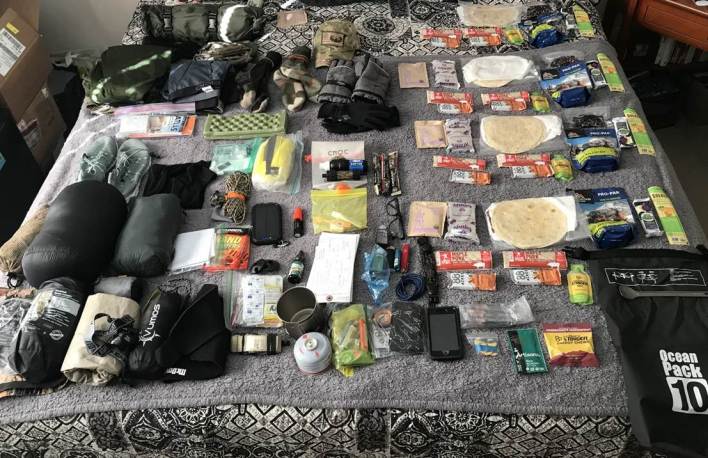
Above is an example of roughly ten pounds of food, or four days’ worth and some extra snacks. This was back in 2019 when I did a section hike in the Shenandoah National Park, (I had done the first 33 miles six weeks prior and got injured on the trail, so I tied back in to where I got picked up by my shuttle service) back to my vehicle in Waynesboro, VA. (Approximately 75 miles). And in case you’re wondering, yes, I did almost every bit of that food.
WHAT YOU CAN DO NOW:
Now, I’m not saying you need to copy anything I’ve done above. You don’t need to go out and buy thirty packets of walnut and coconut butter. I used them as an example because there are many ways to increase calories per ounce AND reduce your food-pack weight. Even if you shed a pound, that’s one less pound to carry over every mile of a ten-mile hike. So, here is a non-exhaustive list of things you can do now before you build out your pack-food plan.
- Talk with your primary care physician or a registered dietitian if you have medical conditions, food allergies, or questions about fueling sustained exertion. They may have suggestions for lightweight foods that fit your needs. Protein powders can help, but they are not a complete substitute for enough total calories, carbohydrates, fats, and other nutrients.
- I would personally limit foods that are mostly added sugar, but I wouldn’t eliminate all sugar or carbohydrates from a hiking food plan. During long, physically demanding days, carbohydrates can be useful fuel. The goal is a workable balance of calories, nutrition, weight, and foods your stomach tolerates—not a blanket ban on sugar.
- Once you know what you can eat, buy only what you like! I like walnut butter because I’m allergic to peanut butter. I’ve met so many people that can’t stand walnut butter. Just because it’s lightweight and has a lot of calories, doesn’t mean you’re going to like it.
- Try different combinations. As you can see from my layout above, I’ve tried a little bit of everything from freeze dried meals, beef sticks, pita bread, cinnamon bars, almond butter, and even fruit bars to get some natural sugar into my bloodstream while hiking. If I were to go out on a section hike now, ¾ of that food wouldn’t get packed, as I’ve learned to trim it down even more.
- Choose a durable, waterproof food bag if you want to keep your food organized and dry. But a dry bag is NOT a bear-resistant container. Check the rules for the specific trail or park before you go: some areas require an approved bear canister or locker, while others permit properly hung food. Store food, trash, and other scented items as required. No affiliate links, as always—do your due diligence.
- Pack your bag with your normal gear and at least three days’ worth of food, based on your actual route and resupply options. Hiking the Appalachian Trail, I estimated I was burning about 4,500 calories a day. That was my experience, not a universal target. At that rate, three days would be 13,500 calories, and laying out that much food shows how quickly the weight adds up.
- Walk with your pack and just your food. You will soon realize how much food actually weighs while you’re carrying it, and I don’t mean from the grocery store to your car.
- Learn to forage. I wrote an article on sustainment foraging. Practice the actual process of finding, responsibly harvesting, and preparing legal wild foods before an emergency. Foraging can supplement your supplies, but it is not a dependable replacement for packed calories.
- Learn to identify wild edibles. Knowing which plants and mushrooms are edible is a separate skill from collecting them. Study local species with reliable references and expert instruction, and never consume anything you cannot confidently identify as safe.
- Give yourself time to learn from your mistakes. An extra pound isn’t going to kill you, but it could help you to try to figure out a solution to some of your foods to where you have the same calories, but less weight. Again, I’ve tried numerous versions of this philosophy, and unfortunately, it’s trial by error.
CONCLUSION:
Now that you have a decent overview, start thinking about what three days’ worth of food might look like crammed into your backpack. Better to start now than to try to figure it out on the fly during a massive emergency. Once you have that three-day food load assembled, weigh it, carry it with your normal gear, and try eating those foods during a practice hike. You may discover that what looked good on the kitchen table is a different story ten miles down the trail.
I hope this exercise is fun for you, and over time, I’m sure you’ll be comfortable with what types of foods bring you the most enjoyment, calories with the least weight possible. Keep the faith and stay frosty!
Sgt. Silverman.
DISCLAIMER:
This article is for educational and informational purposes and reflects personal hiking, military, and preparedness experience. Food and calorie needs vary with body size, terrain, weather, health, and exertion. Consult a qualified healthcare professional for individualized nutrition advice, particularly if you have medical conditions or food allergies. Follow local food-storage regulations and wildlife guidance, and do not consume wild foods without reliable identification. The author’s field experiences and estimated calorie expenditure are personal accounts, not independently verified measurements.
COPYRIGHT NOTICE
© 2026 Sgt. Silverman / Tertiary Prepper. All Rights Reserved.
This article and all original works published under the pseudonym Sgt. Silverman are the exclusive intellectual property of the author. No portion of this publication may be reproduced, distributed, transmitted, republished, copied, or adapted in any form or by any means without the prior written permission of the author or publisher.
Proper attribution and written permission are required for any use beyond applicable fair use. Unauthorized reproduction, plagiarism, or commercial use may be subject to enforcement under applicable United States copyright laws.
AI-Assisted Visuals & Examples
If you’ve been reading Tertiary Prepper for any length of time, you’ve probably noticed charts, graphs, calculations, and visuals that explain preparedness concepts in ways you don’t normally see discussed. Many of those examples were created with the assistance of artificial intelligence—but only after I gave it very specific instructions on what I wanted to teach.
I don’t use AI to create my preparedness philosophy. I use it to help visualize it.
Many of the tertiary concepts discussed throughout this magazine—such as Sustainment Foraging, Pressure Testing, The Autonomous Recovery Kit (ARK), The Quiet Food Equation, and other original frameworks—are my own ideas and observations. AI simply helps me communicate those concepts through charts, graphics, and examples that make them easier to understand.
Preparedness is rarely black and white. There are very few absolute right or wrong answers—only different experiences, different priorities, and different ways of solving the same problem. My hope is that these articles simply give us another reason to sit around the campfire, challenge conventional thinking, and ponder practical solutions together.




