




You’ve done it. You found the ultimate bug-out location. Life is GREAT! You have every prepping item a property could possibly need, 20 acres of perfect land, and a large home. There are rows of fruit trees, and the prior owner even put in a one-acre mini garden guarded by twenty cantankerous guinea hens. Because if it moves, they will assuredly kill it.
There’s one final gap to fill now: creating the perfect MAG (Mutual Assistance Group). You think back to all the articles you’ve read and videos you’ve watched about putting a group together. Then you mentally build a quick checklist:
☐ Carpenter
☐ Former Military Grunt
☐ EMT / Nurse / or Doctor
☐ Mechanic
☐ Animal Husbandry
You think, “If I can find these five people and offer to have them live here indefinitely, we can more than likely achieve self-sufficiency.” And this is where I think most people miss the biggest part of the equation: CHARACTER first, skills second.
SARENGETI ANALOGY:
When I was in the military, a friend once told me he felt there were three basic types of people in the world. He explained it using the Serengeti. This wasn’t biology, and it sure as heck wasn’t some scientific personality test. It was simply a way to look at how people tend to react when things get difficult.
PREY (BETA) The Gazelle
The gazelle survives through awareness, avoidance, and flight. When it senses danger, its instinct is to create distance instead of confronting the threat. That doesn’t make the gazelle “weak.” Running is what it was built to do.
We all know people who react similarly. When trouble arises, their first instinct is to get away from it, avoid confrontation at all costs, or wait for someone else to handle it.
OPPORTUNIST / PREDATOR (SIGMA) The Vulture, Jackal, or Hyena
This group gets a little more complicated. Some operate alone. Some cooperate. Some capitalize on opportunities created by others. I’m not saying these animals—or people—are automatically bad. I’m saying their behavior may be driven more by opportunity, circumstance, and self-interest.
A vulture waits for an opportunity. A jackal may hunt or scavenge. Hyenas can hunt together and even drive lions away from a kill. Different animals. Different methods. Same point: watch what they actually do.
Translated to people: these may be the individuals who watch the situation, calculate where the advantage lies, cooperate when it benefits them, or exploit weakness when an opportunity presents itself.

APEX PREDATOR (ALPHA) The Lion and Lioness
This is where my friend’s analogy really starts to matter.
A lion’s pride survives because different members perform different roles. They hunt, defend, protect territory, and confront threats together. Nobody does everything, and nobody survives alone just because they look impressive on paper.
Nobody survives because one lion walks around announcing that he’s the Alpha.
The pride survives because its members contribute.
Now put the Serengeti aside for a moment and look around you.
Think about your family. Your coworkers. Your boss. Uncle Bob. Aunt Karen. Heck, dating has created its own vocabulary for this stuff—the Simp, the Chad, the Giga Chad, the Pick-me. The labels change, but the exercise remains useful.
How does this person behave when things become uncomfortable?
Do they freeze? Run? Cooperate? Lead? Follow? Exploit? Create problems? Solve them?
That is where this analogy matters to preparedness.
If you’re considering someone for a Mutual Assistance Group, neighborhood preparedness group, or simply determining who you can depend upon during an emergency, their résumé of preparedness skills is only part of the equation.
The better question is:
Is this person an asset, a liability, or a potential threat?
Someone can own every piece of gear imaginable and possess tremendous technical skills while still being somebody you wouldn’t want anywhere near your family when things go sideways.
On the flip side, the quiet person without the impressive résumé or mountain of gear may be the one who stays calm, contributes, adapts, and becomes indispensable. Don’t get hung up on whether someone is the gazelle, hyena, or lion. Watch what they do.
Behavior tells you far more than the label ever will.
THE TRUST / PERFORMANCE MATRIX:
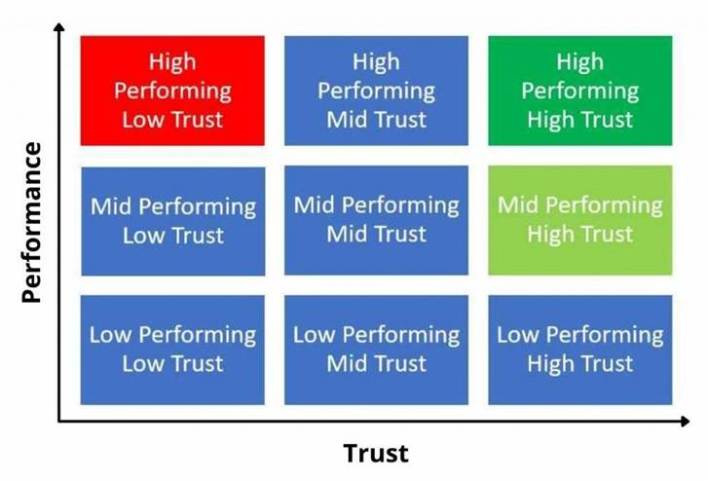
Years ago, I saw Simon Sinek explain a Performance-versus-Trust concept using the Navy SEALs as the example. And it isn’t what you think. The point goes beyond performance. We tend to get fixated on the TOP PERFORMER. Sales. Skillsets. Work. Life. If they perform, we assume they’re the person we want. We see this play out every day in corporate America.
The other side of that equation is TRUST. And I’m ad-libbing the way I remember Sinek explaining it, so a little grace please: I might trust you with my life, but can I trust you with my money and my wife? That’s the bigger question. Performance tells me what you CAN do. Trust starts telling me WHO I’m actually dealing with. Moderate performance with high trust may still give you someone worth building around. High performance with low trust? For me, that’s a no-go.
I expanded that basic idea into the scale below as a practical way to think about MAG candidates.
WHAT ARE SOME SKILLS OF VETTING:
This isn’t an exhaustive list, but it gives you a baseline for what you should work on before trying to vet somebody else. And don’t get hung up on IQ or raw skill alone. IQ can tell you something about cognitive ability—reasoning, learning, and problem solving—but it does not tell you how someone regulates emotion, responds to adversity, functions inside a group, or whether they can be trusted. Look at EQ—how they understand and manage emotion in themselves and in relationships. Look at AQ—how they respond when adversity, failure, pressure, and uncertainty enter the equation. Use an AQAL-type lens—not as a personality test, but as a broader map for looking at the person from multiple perspectives. Then evaluate TRUST across all of it. In other words, don’t vet the résumé. Vet the person.

- Self-Assessment: Understand your own weaknesses, biases, and what you are looking for in a group member.
- Character Evaluation: Identify what a person WILL do under stress, not what they SAY they can do.
- IQ — Can they THINK? Reasoning, learning and problem solving. Can they understand complicated problems, absorb new information, recognize cause and effect, and make sound decisions? IQ matters, but intelligence by itself tells you very little about character.
- EQ — Can they manage THEMSELVES & OTHERS? Self-awareness, emotional control, empathy and communication. Can they keep themselves together when emotions run high? Can they read the room, communicate without unnecessarily escalating conflict, and recognize what other people may be experiencing?
- AQ — What happens when things GO SIDEWAYS? This is where resilience, adaptability and intestinal fortitude start showing up. Adversity Quotient looks at how someone responds when the plan fails, pressure builds, or circumstances move outside their control. For vetting purposes, I’m less interested in how someone performs when everything is going right than what happens when it isn’t.
- AQAL — Who are they AS A WHOLE? AQAL stands for All Quadrants, All Levels, All Lines, All States, All Types. I’m not trying to turn this into an Integral Theory dissertation. I’m borrowing the lens because it forces me to look beyond one dimension of a person: what’s happening internally, what they actually do externally, how they function individually, how they operate inside a group, and how context may change what I’m seeing.
- TRUST — Can I RELY ON THEM? Trust is not a quotient or a one-time test score. It is something you calibrate through observed behavior over time. Do their words and actions line up? Do they tell the truth when the truth costs them something? Do they follow through, accept accountability, protect the group, respect boundaries, and remain reliable when nobody is watching? Skills may get someone through the door. Trust helps determine how far inside your circle they should ever be allowed.
- Pattern Recognition: Observe consistency over time, not isolated actions or words.
- Situational Awareness: Assess how individuals behave in different environments, not just controlled conversations.
- Emotional Control: Remain objective and not impressed by skills, charisma, or shared interests.
- Behavioral Observation: Watch actions, follow-through, and reactions under pressure.
- Communication Filtering: Identify truth vs. exaggeration vs. deflection. (This one can be difficult to learn because manipulative behavior, gaslighting, exaggeration, and deflection aren’t always obvious at first.)
- Group Compatibility Analysis: Evaluate alignment with values, structure, and mission.
- Decisiveness: Know when to include, delay, or reject someone without hesitation.
A lot of these same skills show up in negotiation, too. The difference is timing. Vetting helps you decide who you should trust before you ever put them inside your circle. Negotiation helps you deal with people once the interaction is already happening. The chart below takes what I’ve been talking about and puts it into a quick visual, so I don’t turn this into a 20-page mind-numbing dissertation.

CONCLUSION:
Everything I’ve listed above is a baseline. Nobody is perfect, and sometimes you may not have the luxury of spending months evaluating someone before circumstances force a decision. But if you DO have the time now, use it. Watch people closely. Listen to what they are saying while watching their body language. Pressure test any assumptions you might have. Look for behavioral patterns that seem out of the ordinary. Hopefully, you can print this chart off and keep it as a MAG VETTING QUICK GUIDE for future reference.
Stay frosty, keep learning new tertiary prepper skills, and practice the vetting framework whenever you can!
Written by Sgt. Silverman exclusively for Tertiary Prepper. © 2026. All rights reserved.
WANT TO GO DEEPER?
These are starting points for readers who want to explore the underlying concepts beyond the shorthand I use in this article:
IQ — MIT OpenCourseWare, Intelligence
EQ — University of Illinois Extension, Emotional Intelligence in the Workplace
AQ — PEAK Learning, Adversity Quotient and CORE
AQAL — Integral Life, Welcome to the Integral Approach
AQAL — Integral Life, AQAL Glossary
TRUST / PERFORMANCE — Simon Sinek, The Infinite Game (see the Performance vs. Trust / Trusting Teams discussion).
Editorial note: IQ, EQ, AQ, AQAL, and Trust are not interchangeable measures. In this framework they are separate lenses used together to reduce the chance of overvaluing raw skill or résumé strength.
DISCLAIMER:
This article is for educational and informational purposes only and reflects my personal observations and approach to evaluating people for a Mutual Assistance Group. Human behavior is complicated, and no checklist, personality label, intelligence measure, or vetting framework can guarantee how someone will act in a real emergency. Use this framework as a baseline, not a diagnosis or substitute for your own judgment. Take your time when circumstances allow, protect your family and group, and make decisions based on observed behavior and patterns over time.
COPYRIGHT NOTICE
© 2026 Sgt. Silverman / Tertiary Prepper. All Rights Reserved.
This article and all original works published under the pseudonym Sgt. Silverman are the exclusive intellectual property of the author. No portion of this publication may be reproduced, distributed, transmitted, republished, copied, or adapted in any form or by any means without the prior written permission of the author or publisher.
Proper attribution and written permission are required for any use beyond applicable fair use. Unauthorized reproduction, plagiarism, or commercial use may be subject to enforcement under applicable United States copyright laws.
AI-Assisted Visuals & Examples
If you’ve been reading Tertiary Prepper for any length of time, you’ve probably noticed charts, graphs, calculations, and visuals that explain preparedness concepts in ways you don’t normally see discussed. Many of those examples were created with the assistance of artificial intelligence—but only after I gave it extremely specific instructions on what I wanted to teach.
I don’t use AI to create my preparedness philosophy. I use it to help visualize it.
Many of the tertiary concepts and preparedness applications discussed throughout this magazine—such as Sustainment Foraging, The Autonomous Recovery Kit (ARK), The Quiet Food Equation, my application of Pressure Testing to preparedness, and other original frameworks—grew out of my own ideas, observations, and experience.
Preparedness is rarely black and white. There are very few absolute right or wrong answers—only different experiences, different priorities, and diverse ways of solving the same problem. My hope is that these articles simply give us another reason to sit around the campfire, challenge conventional thinking, and ponder practical solutions together.




