




There is a saying many know: “The enemy of my enemy is my friend.” There is more truth to that statement than most people can comprehend as it can apply not only to people, but to animals, (sheep dogs protecting the flock), all the way down to the insect kingdom. I authored an article years back called GARDEN OPSEC which discusses the importance of creating a front-line defense of beneficial insects for your crops. But in this article, I am going to take it a step further as even beneficial insects need support. Because whether you see it or not, your entire garden is waging a micro-war that you will never see. It is vicious. It is unrelenting. It is here that your food is slowly becoming something else’s food, and thus, your beneficial insect are the silent army you have deployed to counter such attacks.
However, even a strong and deadly army can be attacked, and eradicated.
In the military, there is an acronym called QRF or better known as “Quick Reaction Force,” when it comes to protecting your garden, QRF from here on in stands for “QUIET Reaction Force.” I will explain with an analogy… If your beneficial insects are the Airborne Infantry of your garden, sent in (by you) to protect the invading army of voracious crop-devouring psychopaths, then Carnivorous Plants are the covert “QRF” support element deployed at a safe distance like artillery batteries, to keep your beneficial insect army in the game doing their jobs unhindered and for as long as possible.
In my garden, during peak yellowjacket pressure, I’ve deliberately introduced beneficial insects at my own expense. Yellowjackets of course don’t recognize my biological-control plan, nor do they care. To them, if soft, crawls and or flies, that = yummy. Now, if they prey upon those beneficials, they are degrading a resource I am intentionally trying to establish. So how can I reduce that pressure without spraying the garden or spending my summer locating underground nests? (Which, I ironically end up finding somehow anyway by mowing the lawn right over them. Oh yes, fun times.)
By introducing a Biological Defense system like a carnivorous plant bog garden.
BIOLOGICAL DEFENSE SYSTEM:
When you are growing a garden for food, things such as companion planting, beneficial insects, nematodes, and so on are crucial to achieving a bumper crop, and that is if you have enough water and sunlight. Basically, everything needs to be perfect… and it never is. And it is here that I began realizing that my Garden Opsec deployed insect soldiers were slowly being destroyed as ferocious predators such as yellowjackets are opportunistic by nature. They don’t distinguish “good bug” from “bad bug.” And they like to eat pollinators, soft-bodied insects, and even beneficial insects.
This is when I knew I needed to consider another biological support layer. Reinforcements.
Enter the QRF.
To keep using the same analogy, a commander does NOT put the artillery right next to the rifleman’s foxhole. He puts it in a position where it can support the fight.
This isn’t about replacing established pest-management practices. It’s about adding another contingency.
Today, protecting beneficial insects may seem tertiary. If access to pesticides, replacement insects—or the grocery store itself—disappears, that tertiary capability can become primary overnight.
THE DEPLOYMENT STRATEGY:
I tried to show an example below of what I’ve done with my vegetable garden by placing my carnivorous bog garden far enough, but close enough to give some of the predatory hunters, like yellowjackets, a quick detour. The AI picture also shows the different types of beneficials, and of course, that which preys on them as well. (I spent way too much time explaining to ChatGPT what it should look like, and well, after the seventh iteration, this is probably as good as it is going to get. Hopefully it helps explain the strategy a little easier.)
You see, many pitcher plants secrete a nectar along their upper rim, which for me, is what I’m looking for. Sarracenia purpurea for example grows low to the ground and seems to attract the most yellowjackets that I have witnessed in my field observations.
Now, don’t misunderstand this; I’m not trying to eradicate ALL of them, I am using the bog-garden to help reduce their insatiable appetite by introducing a layered biological interception “zone”. The yellowjackets do serve a purpose as they attack many destructive caterpillars and moth larvae. But releasing ladybug larvae, well, those are delicious too apparently.

HOW TO BUILD YOUR OWN SMALL BOG GARDEN:
Just like your investment in beneficial insects, this too will include you making an investment. But the great thing is, the right types of carnivorous plants in your area should last you year after year if you take care of them properly. Here is a link for understanding physiology, growth, nutrient allocation and scaling relationships among leaf traits in 10 carnivorous plant species.
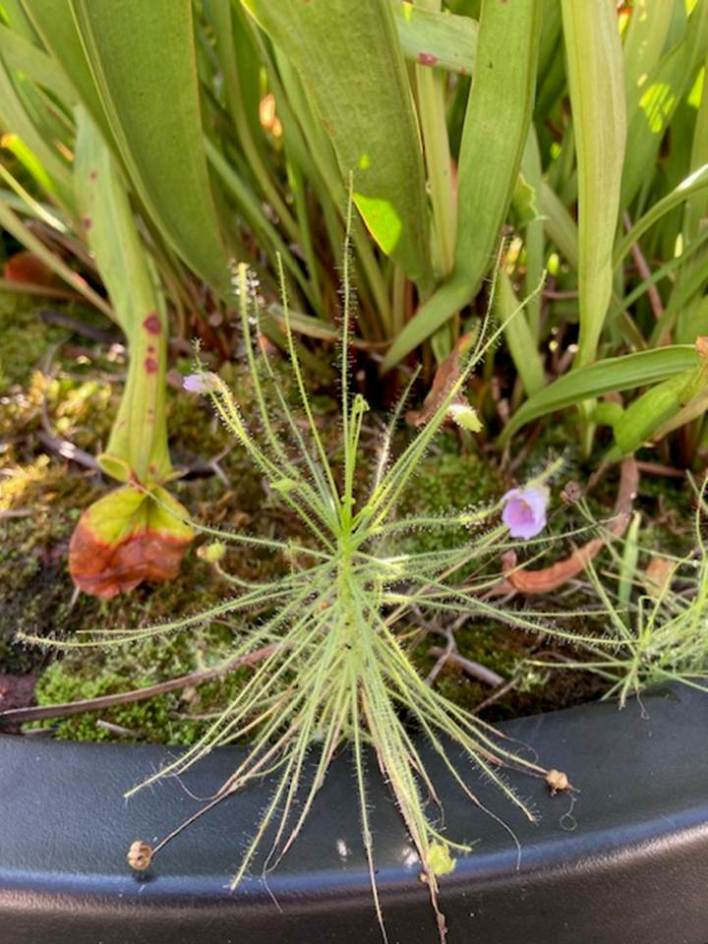
Byblis Liniflora growing along the edges of Sgt. Silverman’s Pitcher Plant Mini Bog Garden
THE MATERIALS:
Although this is not an exhaustive list, you should first understand everything about the types of carnivorous plants that grow well in your geographic location. For example, I can’t comfortably grow Cephalotus or Nepenthes outside year-round in the Carolinas, as I would need to somehow keep them alive during the winter. So, I needed the right type of carnivorous plants for my growing area. And before giving a list of materials, I would watch as many YouTube videos and read as many blogs as you can, and even read Peter D’Amato’s book, “The Savage Garden.” This by far is one of the best books I have read on Carnivorous Plants, and I am hoping to do a Knowledge Gear review of this book at some point. Here are some materials to help you get started:
- The Bog container – I purchased a 30” round one at a Home Center, but you don’t need to use a storebought one. I’ve seen people repurpose old cast iron tubs, old wooden crates with plastic lining, even old satellite dishes, so think unconventionally, as you may need to be creative someday.
- The medium should be based on the needs of the species you are growing—commonly nutrient-poor sphagnum peat and/or long-fiber sphagnum with suitable mineral-free aeration material such as silica sand or perlite. I won’t get into the specifics and ratios, as it depends on the types of plants you are growing, but you will find it’s rather easy to do.
- The plants – I have purchased all my plants from a reputable Carnivorous Plant online nursery out of California, but many carnivorous plants can also be started from seed.
- NOTE: Please avoid field collection if possible.
- Use low-mineral water such as rainwater, distilled water, or reverse-osmosis water. Avoid mineral-rich tap or bottled water unless you know its dissolved-solids level is suitable for the species.
- Gloves, water pitchers and other minor materials may be needed but are not crucial. Once you have watched a few videos you will see it is rather easy to do whether be a small bog, or a gigantic one. Just remember, a larger bog garden creates more carnivorous-plant trapping area, which may also increase captures of insects you consider beneficial or useful, depending on plant selection and local insect activity.
CONCLUSION:
Regardless of what you do, growing a garden and harvesting crops can be challenging at times. A carnivorous bog garden is an actionable tertiary plan that can hopefully reduce beneficial insect casualties.
All the best in building your carnivorous bog garden, and hopefully your garden will reward the experiment in the future!
Sgt. Silverman
DISCLAIMER:
I am not an entomologist, horticulturist, agronomist, or pest-management professional. The information in this article is for educational and informational purposes only and reflects personal field observations and preparedness concepts. It is not professional horticultural, entomological, agricultural, or pest-management advice. Research local species, growing requirements, and applicable regulations before introducing organisms or changing pest-management practices.
COPYRIGHT NOTICE
© 2026 Sgt. Silverman / Tertiary Prepper. All Rights Reserved.
This article and all original works published under the pseudonym Sgt. Silverman are the exclusive intellectual property of the author. No portion of this publication may be reproduced, distributed, transmitted, republished, copied, or adapted in any form or by any means without the prior written permission of the author or publisher.
Proper attribution and written permission are required for any use beyond applicable fair use. Unauthorized reproduction, plagiarism, or commercial use may be subject to enforcement under applicable United States copyright laws.
AI-Assisted Visuals & Examples
If you’ve been reading Tertiary Prepper for any length of time, you’ve probably noticed charts, graphs, calculations, and visuals that explain preparedness concepts in ways you don’t normally see discussed. Many of those examples were created with the assistance of artificial intelligence—but only after I gave it very specific instructions on what I wanted to teach.
I don’t use AI to create my preparedness philosophy. I use it to help visualize it.
Many of the tertiary concepts discussed throughout this magazine—such as Sustainment Foraging, Pressure Testing, The Autonomous Recovery Kit (ARK), The Quiet Food Equation, and other original frameworks—are my own ideas and observations. AI simply helps me communicate those concepts through charts, graphics, and examples that make them easier to understand.
Preparedness is rarely black and white. There are very few absolute right or wrong answers—only different experiences, different priorities, and different ways of solving the same problem. My hope is that these articles simply give us another reason to sit around the campfire, challenge conventional thinking, and ponder practical solutions together.




